
WARSAW, JULY 3, 2025: Asynchronics, a Polish software company specializing in system-level simulation, and NewSpace Systems, a global leader in space hardware manufacturing, have announced the start of their long-term collaboration. This partnership aims to provide mission teams with a new level of reliability and system-level insight, addressing one of the most persistent challenges in the small satellite sector: high failure rates resulting from poor system integration and incomplete pre-flight validation.
Over the past two decades, nearly 40% of small satellite missions have ended in partial or total failure. These aren't isolated incidents. While some failures stem from launch vehicle issues or hardware breakdowns, a growing number are due to software errors, integration gaps, and communication protocols that don't perform as expected once the satellite is in orbit.
Such failures can cost up to $60 million per mission, and their consequences extend far beyond hardware, impacting reputations, delaying national programs, and eroding investor confidence. Despite the magnitude of these risks, the testing processes of many smallsat teams have not kept pace, often focusing on hardware-level durability and overlooking the integration challenges that emerge only when systems work together in real mission conditions.
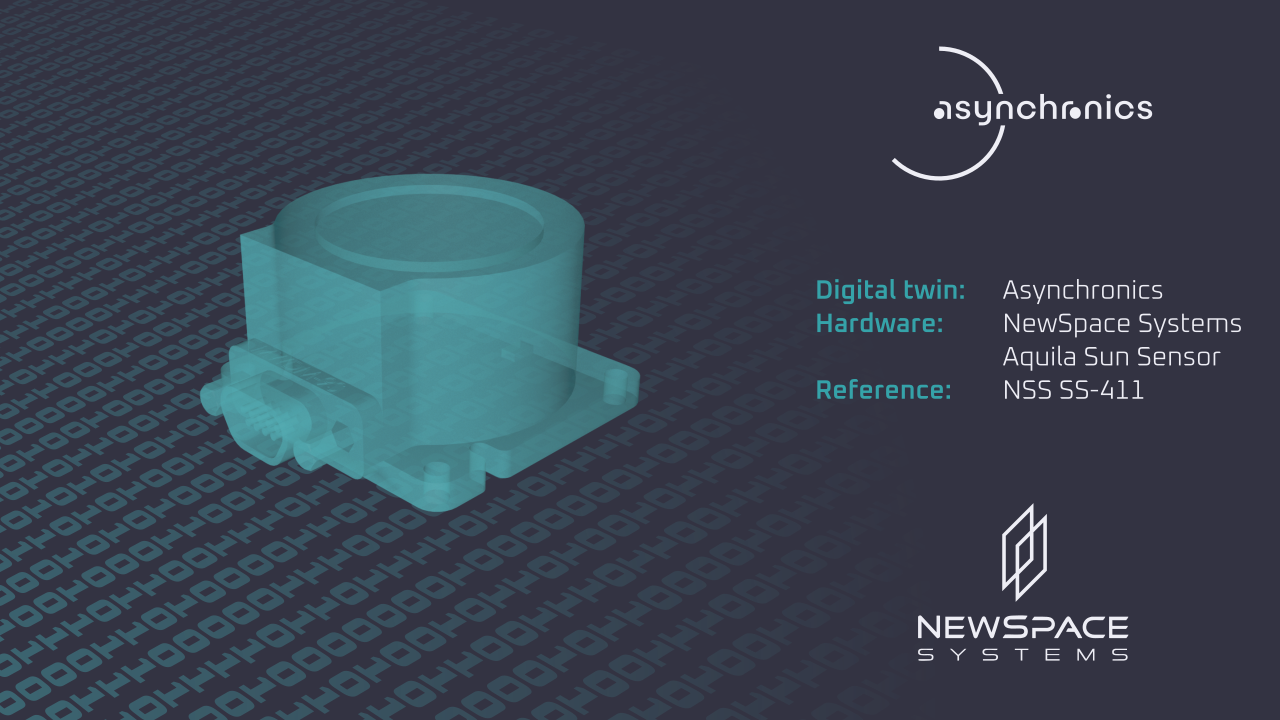
This is precisely the gap that the first outcome of the collaboration is designed to address. The Aquila model, a digital twin of NSS's flight-proven Aquila sun sensor, allows mission teams to replicate with high fidelity how this sensor behaves under operational conditions. It not only captures the expected performance but also reveals how the sensor responds to edge cases like packet errors, voltage instabilities, and telemetry anomalies.
By integrating the Aquila model into NeXosim™ — Asynchronics' open-source simulator — engineers can recreate complete mission scenarios, from sun vector estimation under varying lighting conditions to handling malformed commands and resets. This approach uncovers hidden integration problems and software errors that traditional hardware tests often miss, giving teams a chance to resolve these issues early — long before launch.
The partnership between Asynchronics and NewSpace Systems seeks to change that. Aquila is just the first step. Both companies have already begun work on the next digital twins: one for the GEMINI-SR5 GPS Receiver and another for the PEGASUS-1 Magnetometer. These upcoming models reflect a shared commitment to building a comprehensive suite of digital validation tools, enabling mission teams to understand not only what works in isolation but also how everything fits together in orbit.
Too many small satellite missions have been lost to software integration errors that no one spotted in lab testing. We're proud to have partnered with NewSpace Systems, and even more excited that this success sets the stage for future digital twins — because reliability is about validating how systems work together, not just as individual parts.
Serge Barral, CEO of Asynchronics
The Aquila digital twin has shown us the potential of combining high-fidelity hardware models with advanced system-level simulation. We're excited to see how this partnership grows and continues to push the industry forward.
Lambert de Wet, Chief Technology Officer at NewSpace Systems
The Aquila model is designed to be adopted by spacecraft integrators as they prepare for upcoming launches. Its ability to integrate real-time data flows, power constraints, and protocol-level exchanges represents a shift in how the New Space sector views validation: not as an afterthought but as a core part of mission design.